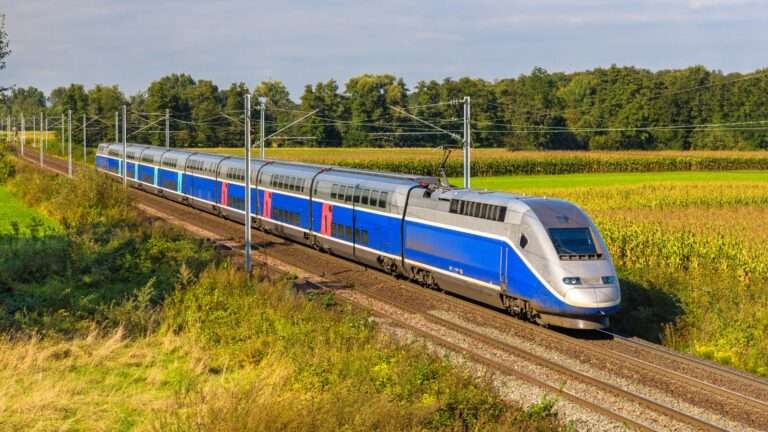
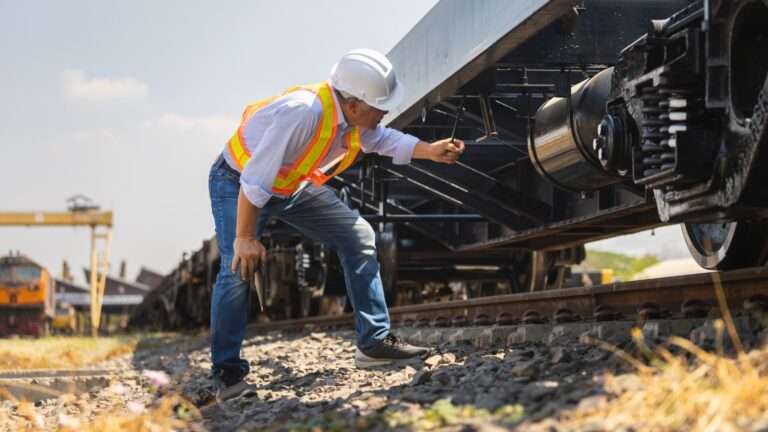
In rail transport, a train door opens and closes hundreds of times a day. A track section withstands thousands of train passes every month. An overhead line continuously powers trains running at 300 km/h. At this scale, any unanticipated failure leads to delays, costly downtime, and sometimes safety risks for passengers.
According to Fortune Business Insights, the global railway maintenance machinery market was valued at USD 4.79 billion in 2025 and is expected to grow from USD 5.07 billion in 2026 to USD 8.05 billion by 2034. Operators who fail to embrace this shift risk falling behind strategically.
Yet most rail players remain stuck in maintenance models that only exploit a fraction of their data’s potential. This article sets out the diagnosis.
Rail: a unique environment for maintenance
The rail sector is unlike any other industrial environment. Three characteristics fundamentally set it apart.
First, the diversity of monitored equipment is considerable. A single network includes rolling stock components such as doors, brakes, HVAC systems and compressors, linear infrastructure such as tracks, overhead lines and switches, and signalling systems. Each equipment category generates different types of data, at different frequencies, with distinct degradation patterns. A predictive maintenance solution that works for high-speed train doors cannot be directly applied to track geometry monitoring without significant adaptation.
Second, safety constraints are absolute. In sectors such as aerospace or nuclear, tolerance for error is zero. Rail operates under similar conditions. A false negative, meaning an undetected failure, can have serious consequences. A false positive, meaning an unnecessary alert, disrupts operations and erodes trust among field teams. Striking the right balance between sensitivity and specificity is critical.
Third, data volumes are massive but often underutilised. A national operator can generate more than 10 million records for a single type of equipment within a few months. The data exists, collected through onboard systems and measurement trains. However, the path from data collection to predictive use remains full of obstacles.
Preventive, condition-based, predictive: where does the sector stand?
To understand the current state of rail maintenance, it is essential to distinguish between three levels of maturity.
Preventive maintenance, or time-based maintenance, involves performing interventions at fixed intervals regardless of the actual condition of the equipment. It remains the dominant approach across a large portion of the global rail fleet. Components are replaced after a certain number of operating hours or kilometres, based on manufacturer recommendations. While reassuring from a safety perspective, this approach is costly. It leads to unnecessary interventions on healthy equipment and does not prevent failures that occur between scheduled checks.
Condition-based maintenance represents a first step forward. Equipment condition indicators such as temperature, vibration or measured wear are monitored, and interventions are triggered when thresholds are exceeded. Many rail operators have reached this stage, especially for critical assets. This is a clear improvement, but it remains reactive. It detects degraded states but does not anticipate how degradation will evolve.
Predictive maintenance goes further. It does not simply state that equipment is degraded. It projects forward: this component will reach a critical state in a given number of days or weeks, and here is the likely cause. It shifts from a snapshot to a trajectory, from observation to anticipation. This is where most rail projects hit a wall.
The “cold start” barrier: why supervised AI is not enough
The promise of artificial intelligence in maintenance is often based on a simple idea: collect historical failure data, train an algorithm to recognise early warning signals, and deploy the model in production. This is the supervised learning paradigm, and it works very well in certain contexts.
In rail, however, it encounters a structural limitation: the lack of labelled failure data.
There are several reasons for this.
Rail equipment is designed to last. A well-maintained door system can operate for years without major failure. This is good news operationally, but problematic for supervised AI, which requires hundreds or thousands of failure examples to learn effectively.
When failures do occur, they are rarely documented in a way that is usable for algorithms. Field feedback is often textual, informal and heterogeneous. The link between a failure event and the corresponding sensor data is frequently approximate, if not impossible to establish.
Finally, every new type of equipment resets the clock. A new train generation or subsystem comes with no historical failure data. This is the industrial “cold start” problem, and it is endemic in rail, where asset lifecycles span decades.
The result is clear: data teams spend months preparing datasets, only to realise they lack sufficient failure examples to train reliable supervised models. Projects stall.
The alternative: learning normal behaviour instead of failures
A fundamentally different approach exists. Instead of trying to recognise failures, which requires having observed them beforehand, it focuses on learning what normal behaviour looks like. Any deviation from this learned baseline becomes a signal.
This is the principle of unsupervised learning applied to maintenance.
In practice, the algorithm ingests sensor data from healthy equipment, builds a mathematical model of nominal behaviour, and continuously monitors new data to detect deviations.
This approach offers three decisive advantages in the rail context.
- It solves the cold start problem. Only normal operating data is needed to begin. No failure history is required. New equipment can be monitored from its first weeks in service.
- It detects the unexpected. A supervised model can only recognise failure types it has been trained on. An unsupervised model detects any anomaly, including failure modes never seen before. In a complex environment such as rail, this is a major advantage.
- It improves with domain expertise. When an anomaly is detected, maintenance experts can validate or reject the alert. This feedback is integrated into the model, which progressively refines its understanding of meaningful deviations. This is the principle of active learning, where humans remain part of the loop.
What this changes in practice for rail operators
Moving to unsupervised predictive maintenance is not just a change of algorithm. It transforms the entire maintenance value chain.
For rolling stock, it becomes possible to monitor tens of thousands of door opening and closing cycles, assign a health score to each component, automatically identify which train, which vehicle and which specific part is drifting, and generate targeted work orders. “No Fault Found” interventions decrease significantly.
For linear infrastructure, the same logic applies at network scale. Operators can project track geometry degradation kilometre by kilometre, anticipate priority zones for tamping or grinding, and optimise maintenance planning based on actual and projected asset condition.
In both cases, the key shift is the same: moving from rule-based maintenance to maintenance driven by the real, measured and projected state of each asset.
This is a technological leap, and the rail sector is ready to take it.
This article is the first in a series dedicated to predictive maintenance in the rail sector. In the next article, we will explore how predictive models can be built without any failure history.