“We don’t have enough failure data to train a model.”
Any maintenance manager or data scientist who has attempted to deploy predictive maintenance in industry has heard or said this at some point. In rail, it often sounds like a final verdict.
Yet it is based on an assumption that needs to be challenged: the idea that to predict a failure, you must first have observed hundreds of them.
The supervised paradigm and its structural limits
The dominant approach in machine learning for predictive maintenance relies on supervised learning. The principle is intuitive: an algorithm is trained on a dataset where each observation is labelled (“normal” or “faulty”), learns to distinguish between the two, and is then deployed to classify new data in real time.
This paradigm has proven effective in sectors where failures are frequent and well documented. But in rail, the required conditions are rarely met.
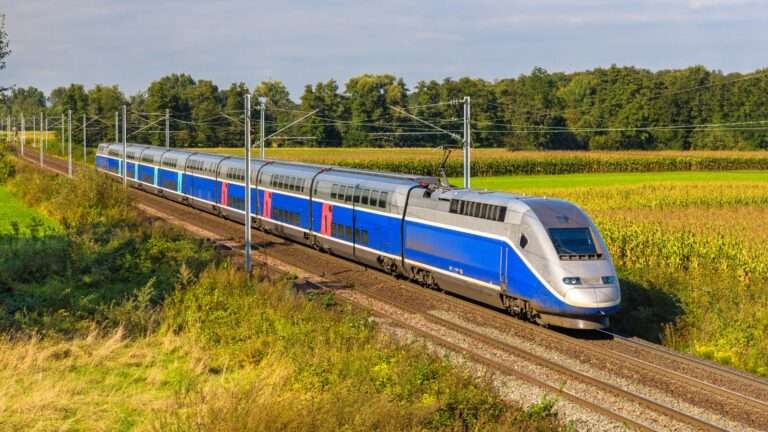
A high-speed train door system can perform 75,000 opening and closing cycles over a few weeks without a single failure. Equipment is robust, lifecycles span years, and when failures occur, the precise correlation between the event and preceding sensor signals is rarely captured in information systems.
The result is a dataset composed of millions of “normal” records and a handful of poorly documented “abnormal” events. The imbalance is so extreme that no supervised algorithm can produce a reliable model.
This issue has a name in the literature: the cold start problem. It is not a matter of digital maturity or data quality. It is a structural constraint of the domain.
A recent study published in Sensors (MDPI, 2024) highlights the growing use of AI in rail maintenance, with increasing interest in unsupervised approaches and ensemble methods to address the scarcity of labelled failure data.
Reframing the problem: learning what is normal
The approach we advocate at Amiral Technologies is based on a shift in perspective. Instead of asking “what does a failure look like?”, we ask “what does normal behaviour look like?”
In practice, our software, DiagFit, ingests sensor data from equipment operating under nominal conditions: currents, voltages, speeds, temperatures, positions and pressures. From these signals, it builds a multivariate mathematical model that captures the “signature” of normal behaviour.
This model defines what we call a “Green Zone”: the space of expected behaviours.
This modelling relies on scientific foundations rooted in Automatic Control and Control Theory, not generic deep learning. The distinction is critical. While deep neural networks often function as black boxes requiring large volumes of labelled data, our approach leverages the physical structure of industrial signals. It captures relationships between variables, temporal dynamics and correlations that reflect the mechanical, electrical or hydraulic behaviour of the equipment.
Once the Green Zone is established, each new data point is projected into this space. If it falls outside the normal range, the system generates an anomaly score.
This score is not binary. It is a continuous distance measuring deviation from learned behaviour. The higher the score, the more significant the drift.
This is what we call “Blind Mode”: the ability to build a monitoring model without any prior anomaly data.
From health score to root cause identification
Detecting a drift is only the first step. For a predictive system to be operationally useful, it must answer two additional questions: which specific asset is affected, and why?
Let us take a concrete example. A rail operator monitors door systems across its fleet. The system assigns a health score to each opening and closing cycle of every door, on every vehicle, in every train.
When a score exceeds a critical threshold, the algorithm does not simply raise an alert. It automatically identifies which variable is responsible for the degradation.
This Root Cause Analysis mechanism transforms a generic alert (“train 57 has an issue”) into an actionable diagnosis (“vehicle 15, DCU 3, shows motor overcurrent on the door circuit”).
Maintenance teams receive precise work orders, with clear identification of the component and likely cause. “Blind” interventions, where technicians investigate without knowing what to look for, are eliminated.
This represents a major shift for field teams. Diagnostics that once required hours of manual investigation are automated. The rate of “No Fault Found” interventions drops dramatically.
The human in the loop: active learning
A common objection to unsupervised learning is the following: “If the algorithm has never seen a failure, how can it know whether a detected anomaly is truly a precursor to failure and not just a change in operating conditions?”
This is a valid concern, and precisely why unsupervised approaches must include humans in the loop.
In DiagFit, every alert is reviewed by a domain expert. The maintenance engineer can validate the alert (“yes, this is a genuine precursor, schedule an intervention”) or reject it (“no, this behaviour reflects a normal change in operating conditions”).
This feedback is integrated into the model, which progressively refines its understanding of the boundary between meaningful drift and normal variability.
This is the principle of active learning. The model initially reacts to any deviation, then becomes more precise over time based on field feedback. After several validation cycles, it has learned not only the physical normality of the equipment but also the operational context of the operator.
This human-machine loop is intentional. Predictive maintenance will not replace domain expertise. It is designed to augment it.
A system generating hundreds of unqualified alerts will quickly be ignored by already overstretched teams. A system that learns from experts and focuses on meaningful signals will be adopted.
Why this approach is particularly suited to rail
Rail brings together all the conditions that make unsupervised approaches highly relevant.
Equipment is diverse, and each fleet has its own specificities. A model trained on regional train doors will not work for a new generation of high-speed trains. Unsupervised learning adapts to each asset using its own data, without unreliable transfer learning.
Asset renewal cycles are long, with new generations introduced regularly. Blind Mode enables predictive monitoring from commissioning, without waiting years for historical data.
Data volumes are massive: tens of thousands of cycles, hundreds of variables per cycle, millions of records per month for a single equipment type. Learning normal behaviour at this scale is not only feasible, it becomes more robust as data increases.
Finally, the sector’s safety culture requires full traceability of algorithmic reasoning. The combination of health scoring and root cause identification provides a level of explainability that deep learning models cannot guarantee. Experts can understand why an alert is triggered, verify the diagnosis, and make informed decisions.
Predictive maintenance without failure history is not a compromise. It is an approach better suited to the industrial realities of the rail sector than the supervised paradigm that still dominates industry discourse.
Next article: a concrete case study on monitoring tens of thousands of train door cycles, from raw signal analysis to automated diagnosis.