Context: embedded electronics as a critical link in offshore drilling
The customer is an international oil & gas equipment manufacturer specializing in the design and production of drilling tools for offshore well operations.
These tools embed electronics located close to the drill bit, including data acquisition boards designed to measure and record critical parameters such as:
-
electrical voltage
-
temperature
-
accelerations and vibrations
-
overall operating conditions of the tool
Deployed several hundred meters below the surface, in environments exposed to severe mechanical, thermal, and vibrational stresses, these electronic boards are completely inaccessible during operation.
A single board failure can result in:
-
drilling operation shutdown
-
full retrieval of the tool
-
significant operational delays
-
high direct and indirect costs
In this context, the customer aims to improve the reliability of its embedded electronics, without relying on physical inspections that are impossible in the field, or on the original equipment manufacturer for diagnostics.
Challenges: detecting and anticipating invisible failures
The customer’s teams face several major challenges:
❌ No physical access to electronic boards during operation
❌ Overcoming data debt, where legacy platforms require months or years of failure history to build models
❌ Noisy and heterogeneous data from embedded sensors
❌ Difficulty identifying reliable early warning signs prior to failure
The objective is clear: detect abnormal drifts in electronic boards as early as possible – ideally before a failure occurs – in order to anticipate maintenance decisions and limit unplanned downtime.
Approach: modeling the normal behavior of electronic boards
Rather than attempting to predict failures from limited historical failure data, Amiral Technologies deployed its unsupervised approach: modeling the physics of normal behavior, without requiring any failure history.
Step 1 – Model construction on test benches
Voltage data collected during post-production test bench phases were used to generate, with DiagFit, a reference model representing the nominal operating behavior of the electronic boards.
Step 2 – Application to field data
This model was then applied to data collected from electronic boards operating under real offshore drilling conditions, enabling the detection of:
-
significant deviations from normal behavior
-
weak signals acting as failure precursors
-
persistent or evolving anomalies
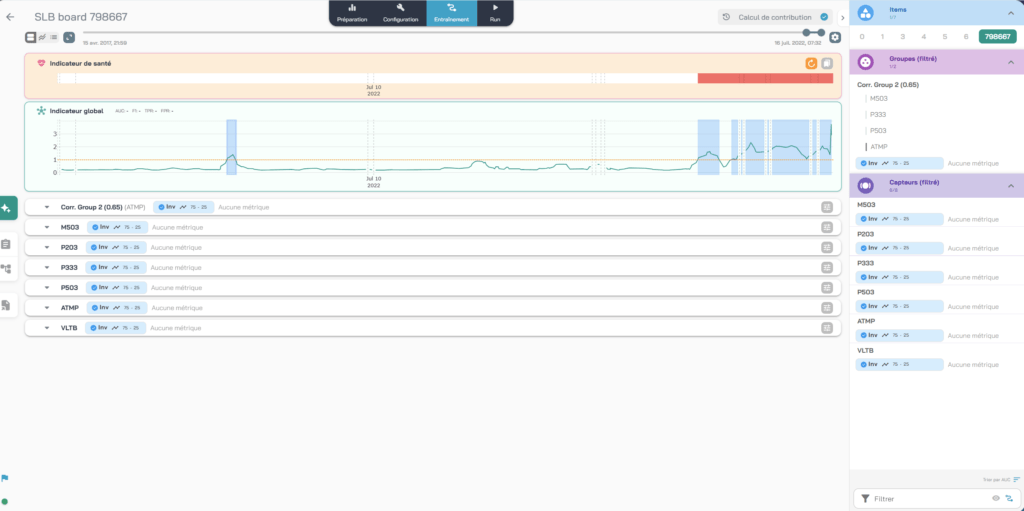
The analysis relies on an anomaly score, designed as a digital sentinel that adapts to changing operating regimes:
-
below a defined threshold: the board is considered healthy
-
above the threshold: an anomaly is detected and requires investigation
Results: proven anticipation capability, without overpromising
Out of the 12 electronic boards analyzed as part of the project:
-
5 failures were detected
-
4 of them exhibited exploitable early warning signs identified before the actual failure occurred
These results demonstrate a strong detection capability, particularly notable given:
-
the limited volume of failure data
-
the criticality of the equipment
-
the operational constraints of offshore drilling
The health indicator highlights an anomaly (blue zones).
This confirms our core belief: AI is not magic – it must be grounded in the physical reality of the signal. When an electrical precursor exists, DiagFit detects it.
Key takeaways for offshore predictive maintenance
This use case highlights several structuring insights for offshore drilling stakeholders:
-
predictive maintenance is applicable to embedded electronics, even in extreme environments
-
the absence of failure history is not a barrier, provided that suitable approaches are adopted
-
weak signal detection enables the creation of actionable anticipation windows
-
a realistic, context-aware approach is essential to avoid false positives
Building on this project, the customer continues its work with its R&D teams to explore additional data sources and further strengthen anticipation capabilities.
When is this type of approach relevant?
This approach is particularly well suited if you operate:
-
critical embedded electronics
-
hard-to-access equipment (offshore, downhole, ATEX zones)
-
systems with little or no failure history
-
complex or noisy sensor data
Go further
Do you operate critical electronic equipment in offshore or constrained environments?
Discover how DiagFit detects weak signals before failure and enables the transition from reactive monitoring to immediate predictive protection.
Contact us to activate your first annual licenses on your most critical assets and eliminate downtime risk.